You get 10,000 people to see your campaign.
Great.
Then 3,000 click.
Also great.
Then 800 become genuinely interested.
A few hundred start seriously considering your product.
And finally…
50 people buy.
So what happened to everyone else?
That’s the interesting part.
Most people know the basic idea behind a marketing funnel. A large audience enters at the top, fewer people continue through each stage, and only a smaller group eventually converts.
But looking at a static funnel diagram doesn’t always make the problem obvious.
That’s why this AIDA funnel example is different.
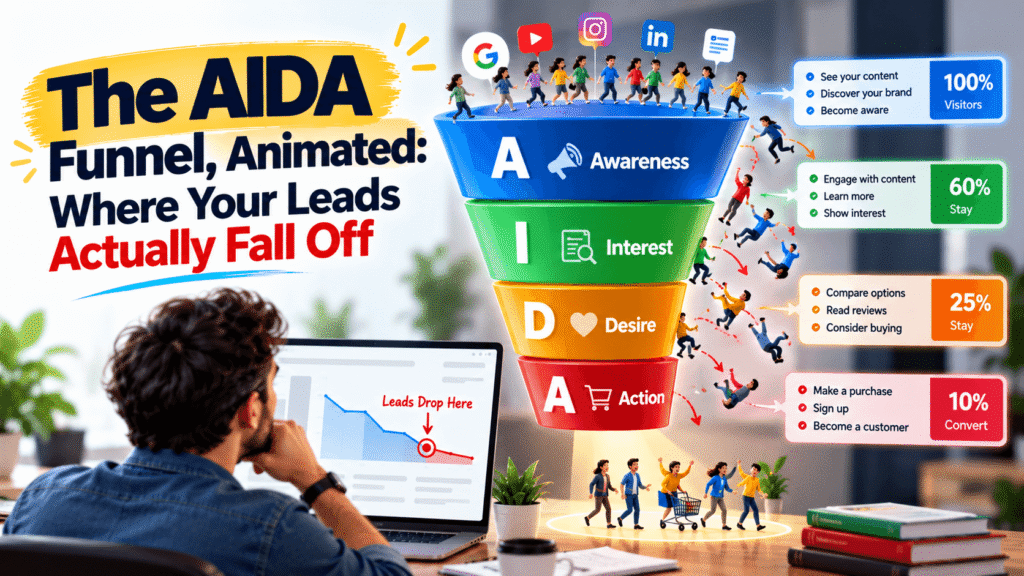
Instead of simply reading about Awareness, Interest, Desire, and Action, imagine watching the people move through the funnel.
You can see where the audience gets smaller.
You can see where leads disappear.
And more importantly, you can start asking why they’re falling off.
That’s exactly what the Play2Lrn AIDA Funnel Simulator is designed to make easier to understand.
What Is the AIDA Funnel?
AIDA stands for:
A — Awareness
I — Interest
D — Desire
A — Action
It is a classic marketing framework used to describe four stages in the journey toward a purchase or another desired response.
In simple terms:
Awareness: “I know this exists.”
Interest: “This might be relevant to me.”
Desire: “I actually want this.”
Action: “I’m ready to do something.”
The AIDA model is often visualized as a funnel because the audience generally becomes smaller as it progresses from initial awareness toward action. Marketing funnel guides from Ahrefs and Shopify similarly describe AIDA as a framework connecting awareness, interest, desire, and action within the customer journey.
But there’s an important detail.
AIDA is a framework, not a law of human behavior.
Real customers don’t always move through the stages in a perfect straight line.
Someone might see your product today, forget about it, search for it three months later, compare competitors, return through an email, and finally buy.
Another customer might discover your brand and purchase five minutes later.
So think of AIDA as a useful way to organize the journey rather than a rule that every customer must follow.
A Simple AIDA Funnel Example
Let’s use a fictional SaaS company.
Imagine it sells an SEO reporting platform.
The company launches a campaign targeting small marketing agencies.
Here’s the funnel:
| Stage | People Remaining | Conversion From Previous Stage |
| Awareness | 10,000 | — |
| Interest | 3,000 | 30% |
| Desire | 900 | 30% |
| Action | 180 | 20% |
At first glance, this looks pretty good.
10,000 people became aware.
3,000 showed interest.
900 developed stronger buying intent.
180 took the desired action.
But here’s the question:
Where did the 7,000 people who didn’t move from Awareness to Interest go?
And what happened to the 2,100 people who showed interest but didn’t develop Desire?
That’s where funnel analysis becomes useful.
The funnel isn’t just about the people who converted.
The drop-offs are the story.
Stage 1: Awareness — “Wait, What’s That?”
Awareness is the top of the funnel.
It’s where someone first encounters your brand, product, service, or problem.
They might discover you through:
- Google Search
- Social media
- YouTube
- Paid advertising
- A blog post
- A recommendation
- A podcast
- Influencer content
- A marketplace
- Word of mouth
At this point, the person may know absolutely nothing about you.
That’s important.
You can’t assume they understand your product.
You can’t assume they trust you.
And you definitely can’t assume they’re ready to buy.
Your first job is simply to earn attention and establish relevance.
For example:
“Still Building SEO Reports Manually?”
That headline might catch the attention of an agency owner who spends hours creating reports.
But it doesn’t immediately ask them to purchase anything.
It starts with their problem.
Where do people fall off?
Usually, the biggest Awareness problem is irrelevance.
Your campaign may reach 10,000 people, but if most of them don’t have the problem you’re solving, they won’t move forward.
That’s not necessarily a landing-page problem.
It could be an audience problem.
Your targeting, keyword choice, creative, or message may simply be reaching the wrong people.
Stage 2: Interest — “Okay, Tell Me More”
Now someone has noticed you.
But awareness doesn’t automatically create interest.
Interest happens when the person decides:
“This might actually be relevant to me.”
This is where your content needs to answer basic questions.
For example:
- What does the product do?
- What problem does it solve?
- Who is it for?
- How does it work?
- Is this better than what I’m doing now?
- Why should I care?
Imagine someone clicks your SEO reporting ad.
They land on your website.
If the page immediately throws a giant pricing table at them without explaining the product, they may leave.
The problem isn’t necessarily that the visitor wasn’t interested.
The problem could be that the page didn’t develop the interest they already had.
That’s an important distinction.
Stage 3: Desire — “I Actually Want This”
Interest and desire aren’t the same thing.
Someone can be interested in your product without wanting to buy it.
Think about how you shop online.
You might spend 20 minutes researching a new laptop.
You’re interested.
But you’re not necessarily ready to purchase.
You start comparing:
- Features
- Price
- Reviews
- Alternatives
- Warranty
- Performance
- Customer experiences
That’s the Desire stage.
The prospect is evaluating whether your solution is worth choosing.
This is where proof becomes extremely important.
You might use:
- Case studies
- Reviews
- Testimonials
- Demonstrations
- Product comparisons
- Before-and-after examples
- Free trials
- Interactive demos
- Detailed product information
The prospect is asking:
“Why should I choose this?”
Stage 4: Action — “Okay, Let’s Do This”
Finally, we reach Action.
This is where the person takes the specific action you want.
That could be:
- Buying a product
- Starting a free trial
- Booking a demo
- Submitting a form
- Creating an account
- Requesting a quote
- Signing up for a newsletter
And this is where marketers sometimes make a strange mistake.
They spend 90% of their effort getting people interested…
Then make the final step incredibly difficult.
The visitor has to:
- Click the CTA.
- Create an account.
- Verify an email.
- Fill out 14 fields.
- Enter payment information.
- Confirm another page.
- Finally get access.
That’s a lot of friction.
The Action stage should make the next step clear and proportionate to the customer’s level of intent.
Modern AIDA guidance similarly emphasizes that the desired action should match the stage of the audience rather than treating every top-of-funnel visitor as ready to purchase.
Here’s Where Your Leads Actually Fall Off
Let’s go back to our example.
We started with:
10,000 Awareness
Then:
3,000 Interest
Then:
900 Desire
Then:
180 Action
The funnel looks something like:
10,000 → 3,000 → 900 → 180
But don’t just look at the final 180.
Look at every transition.
Awareness → Interest
7,000 people disappear.
Possible problems:
- Wrong audience
- Weak headline
- Poor targeting
- Low relevance
- Unclear problem
- Weak creative
Interest → Desire
2,100 people disappear.
Possible problems:
- Not enough product information
- Weak differentiation
- Missing proof
- Unclear benefits
- Poor content
- No reason to choose your product
Desire → Action
720 people disappear.
Possible problems:
- Price
- Lack of trust
- Complicated checkout
- Weak CTA
- Too many form fields
- Poor UX
- Unclear next step
- Unexpected friction
This is why a funnel is more useful when you treat it as a diagnostic tool.
You’re not just asking:
“What’s my conversion rate?”
You’re asking:
“At which stage are people losing momentum?”
The AIDA Funnel Is Not Just About Sales
Here’s another useful point.
Action doesn’t always mean purchase.
If you’re creating top-of-funnel content, asking someone who just discovered your brand to immediately buy can be too large a jump.
Your desired Action might instead be:
- Read another article
- Watch a demonstration
- Try a simulation
- Download a guide
- Subscribe to updates
- Create a free account
For example, someone searching for:
“what is SEO ranking factors”
probably needs education first.
That connects naturally to your previous Play2Lrn article:
Internal link: Every On-Page, Off-Page, and Technical SEO Factor, on One Screen
Someone researching search intent may also benefit from:
Internal link: The 4 Types of Search Intent (And Why Google Cares More Than You Do)
Those aren’t random internal links.
They’re part of a journey.
The reader learns one concept, discovers another related concept, and continues deeper into the topic.
Try the AIDA Funnel Simulator
This is where the concept becomes much more interesting.
Instead of looking at a static AIDA funnel example, use the Play2Lrn AIDA Funnel Simulator.
The idea is simple:
Change the numbers and watch the funnel change.
You can experiment with different stages and see how a change at one point affects the number of people who eventually reach Action.
Imagine you start with:
10,000 → 3,000 → 900 → 180
Now improve the Interest stage.
Instead of 30% moving from Awareness to Interest, imagine 40% do.
Suddenly:
10,000 → 4,000 → 1,200 → 240
Without increasing the number of people entering the funnel, you’ve increased the number reaching Action.
Now imagine the opposite.
Your Awareness stays strong.
Interest stays strong.
But the Desire-to-Action conversion falls.
Suddenly the funnel can look healthy at the top while your final results collapse.
That’s the kind of relationship that’s difficult to understand from a textbook paragraph.
It’s much easier when you can change a variable and watch the funnel respond.
Try the AIDA Funnel Simulator →
What an AIDA Funnel Example Can Teach You About Content
AIDA is also useful when planning content.
Different stages usually need different types of messaging.
Awareness content
Goal:
Get noticed and establish relevance.
Examples:
- Blog posts
- Social posts
- Educational videos
- Search content
- Short-form videos
Interest content
Goal:
Explain the problem and introduce the solution.
Examples:
- Guides
- Tutorials
- Educational articles
- Webinars
- Product explainers
Desire content
Goal:
Help the prospect believe your solution is worth choosing.
Examples:
- Case studies
- Reviews
- Comparisons
- Product demonstrations
- Interactive simulations
Action content
Goal:
Make the next step obvious.
Examples:
- Trial pages
- Demo forms
- Product pages
- Checkout pages
- Signup pages
The exact mix will vary by business, but the basic principle is useful:
Don’t give every stage the same message.
AIDA + Search Intent
There’s another connection worth making.
Your customer’s search intent can tell you something about where they may be in the funnel.
Someone searching:
“what is customer acquisition cost?”
is probably looking for education.
Someone searching:
“CAC LTV calculator”
has a more specific need.
Someone searching:
“best CAC LTV software”
may be much closer to evaluating solutions.
This doesn’t mean search queries perfectly map to AIDA stages.
They don’t.
But the combination can help you think about what the person needs next.
That’s why AIDA works nicely alongside the Play2Lrn Search Intent Classifier.
Internal link: The 4 Types of Search Intent (And Why Google Cares More Than You Do)
AIDA + Attribution
There’s also an interesting connection with the previous article:
Internal link: Marketing Attribution Models Compared: Last-Click vs. Linear vs. Time-Decay
Attribution tells you how different marketing touchpoints receive conversion credit.
AIDA helps you think about where those interactions happen in the journey.
For example:
Social Ad → Blog → Search → Email → Purchase
The social ad may create Awareness.
The blog may develop Interest.
Search may support Desire.
Email may help generate Action.
But attribution might give different amounts of credit to those touchpoints depending on the model.
So:
AIDA helps organize the journey.
Attribution helps analyze credit across the journey.
They’re different concepts, but they can work together.
Don’t Treat Every Funnel Drop-Off as a Marketing Problem
Here’s a mistake worth avoiding.
If people drop off between Desire and Action, you might immediately blame the marketing campaign.
But the problem could actually be the website.
Maybe:
- The page loads slowly.
- The CTA is hard to find.
- The pricing isn’t clear.
- The form doesn’t work properly.
- The checkout has too many steps.
- The mobile experience is frustrating.
- The offer doesn’t match the ad.
In other words, your marketing can successfully move someone through Awareness, Interest, and Desire…
…and then your website can lose them at the final step.
That’s why funnel analysis needs to look beyond campaign metrics.
The customer experience is part of the funnel too.
Why Interactive AIDA Beats a Static Diagram
A traditional AIDA diagram tells you:
Awareness → Interest → Desire → Action
Useful.
But it’s static.
An interactive simulator lets you ask:
“What happens if I improve this stage?”
That’s a completely different learning experience.
You can experiment.
You can make the Interest stage worse.
Improve the Action rate.
Increase the number entering the funnel.
Reduce the drop-off.
Then see the downstream effect.
That’s the core idea behind Play2Lrn’s broader strategy: the content strategy specifically positions its simulations as interactive, single-concept experiences where learners can manipulate variables rather than simply read static explanations.
And for something like a funnel, that approach makes a lot of sense.
Final Takeaway
The easiest way to understand an AIDA funnel example is to stop thinking of it as a pretty marketing diagram.
Think of it as a leak detector.
You start with a large audience.
Some become aware.
Some become interested.
Some develop stronger desire.
Some take action.
And at every stage, people can disappear.
The real marketing question isn’t simply:
“How many people bought?”
It’s:
“Where did we lose people, and why?”
If Awareness is weak, look at targeting and messaging.
If Interest is weak, look at relevance and education.
If Desire is weak, look at differentiation and proof.
If Action is weak, look at friction and the conversion experience.
And instead of memorizing those four stages, open the Play2Lrn AIDA Funnel Simulator and experiment with them.
Change the numbers.
Watch the funnel shrink.
Find the leak.
Then fix it.
Don’t just read the funnel. Watch it move.
FAQs
What is an AIDA funnel?
An AIDA funnel is a marketing framework built around four stages: Awareness, Interest, Desire, and Action. It helps marketers organize how people can progress from discovering an offer to taking a desired action.
What is an AIDA funnel example?
An AIDA funnel example could be a campaign where 10,000 people become aware of a product, 3,000 show interest, 900 develop stronger buying intent, and 180 eventually take action. The numbers are illustrative and help demonstrate how drop-offs can occur at each stage.
What happens at the Awareness stage?
Awareness is when a person first encounters or recognizes a brand, product, service, or problem. The goal is to establish attention and relevance rather than immediately force a purchase.
What is the difference between Interest and Desire?
Interest means the person wants to learn more or sees potential relevance. Desire goes further: the person begins evaluating whether they actually want the solution and whether it is worth choosing.
Does Action always mean a purchase?
No. Depending on the campaign, Action could mean starting a trial, booking a demo, submitting a form, downloading a resource, signing up, or making a purchase.
Is the AIDA funnel always linear?
No. AIDA is useful as a framework, but real customer journeys can move between stages, skip stages, or involve multiple interactions. Some modern discussions specifically caution against treating AIDA as a rigid linear description of every purchase journey.
How can I find where leads fall off?
Break your funnel into the major stages and measure the transition between each stage. Then investigate the stage with the largest or most important drop-off by examining audience quality, messaging, content, trust, UX, pricing, and conversion friction.