
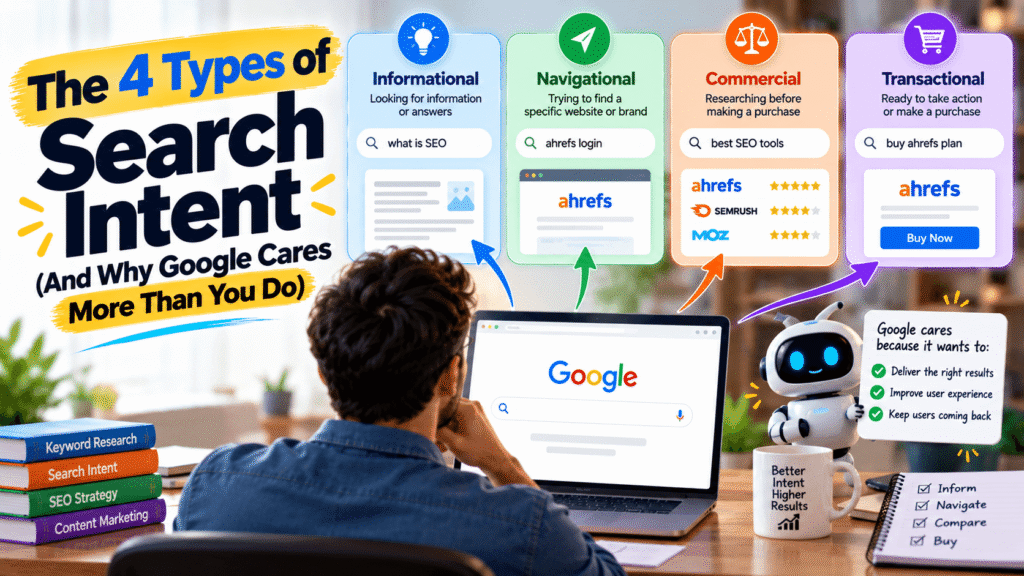
What Are the Types of Search Intent?
You type something into Google.
Maybe it’s:
“What is SEO?”
Or:
“Nike running shoes”
Or:
“best SEO tools for small businesses”
Or:
“buy running shoes online.”
All four are searches, but the person behind each search wants something completely different.
That’s where search intent comes in.
Search intent is the reason behind a search query. It describes what someone is trying to accomplish when they search.
For SEO, understanding search intent is incredibly important because ranking isn’t just about putting the right keyword on a page. Your content also needs to satisfy what the searcher actually wants.
There are four classic types of search intent:
- Informational
- Navigational
- Commercial
- Transactional
And once you understand them, keyword research becomes much easier.
Play2Lrn’s Search Intent Classifier takes this idea one step further. It’s an interactive teaching model where you can enter a query, see the strongest intent signal, and experiment with how small changes in wording can shift the likely intent. (Play2Lrn)
Let’s break down the four types.
1. Informational Search Intent
Informational intent means the person wants to learn something, answer a question, or solve a problem.
They’re not necessarily looking to buy anything.
They’re looking for information.
Examples include:
- “what is search intent”
- “how does SEO work”
- “how to improve website speed”
- “why is my website not ranking”
- “what is Quality Score in Google Ads”
- “how does compound interest work”
The wording often contains phrases such as:
what, why, how, when, where, guide, tutorial, meaning, definition, examples
Example
Imagine someone searches:
“what is search intent?”
They probably don’t want a pricing page.
They don’t necessarily want to contact an SEO agency.
They want an explanation.
So a detailed educational article is likely a better match for that search than a sales page.
That’s the key idea behind informational search intent.
How to create content for informational intent
For these searches, your content should usually:
- Answer the question directly
- Explain the topic clearly
- Use examples
- Cover related questions
- Make the information easy to scan
- Avoid turning the entire article into a sales pitch
For Play2Lrn, this is particularly useful because many simulations can turn complicated concepts into something people can actually experiment with.
2. Navigational Search Intent
Navigational intent is different.
The user already knows where they want to go.
They’re essentially using Google as a shortcut to reach a particular website, company, page, or resource.
Examples:
- “Play2Lrn”
- “Google Search Console login”
- “Semrush”
- “YouTube”
- “LinkedIn login”
- “Ahrefs keyword explorer”
The user isn’t necessarily asking Google to teach them about the brand.
They want to reach a specific destination.
Example
Someone searches:
“Play2Lrn”
Their likely goal is to find Play2Lrn.
Someone searches:
“Google Search Console login”
They aren’t looking for a 2,000-word explanation of what Search Console is.
They want the login or official page.
That’s navigational intent.
Why does this matter for SEO?
If you’re creating content for a navigational query, writing a massive educational article may not be the best approach.
The page should make it easy for the user to find what they’re looking for.
For brands, navigational searches are also important because they can indicate that people already know the brand or product.
3. Commercial Search Intent
Now things get more interesting.
Commercial intent sits somewhere between learning and buying.
The searcher isn’t necessarily ready to purchase immediately, but they’re researching their options.
They’re evaluating.
They’re comparing.
They’re asking:
“Which option should I choose?”
Examples include:
- “best SEO tools”
- “best CRM for startups”
- “Semrush vs Ahrefs”
- “best running shoes for beginners”
- “best project management software”
- “Google Ads alternatives”
- “best email marketing platforms”
Notice something about these searches?
The person isn’t simply asking what something is.
They’re trying to make a decision.
Example
Compare these two searches:
“What is an SEO tool?”
versus:
“Best SEO tools for small businesses.”
The first is primarily informational.
The second has commercial intent.
The searcher may be researching products before eventually purchasing one.
What content works for commercial intent?
This is where formats such as these can work well:
- Comparison articles
- Product roundups
- Reviews
- Alternatives pages
- “Best X” guides
- Feature comparisons
- Buying guides
- Case studies
The goal is to help the searcher evaluate options.
4. Transactional Search Intent
Transactional intent means the user is ready to take an action.
That action might be purchasing a product, signing up for a service, downloading something, booking an appointment, or completing another conversion.
Examples:
- “buy running shoes online”
- “Semrush pricing”
- “book hotel in New York”
- “subscribe to Netflix”
- “buy iPhone 17”
- “sign up for SEO software”
The important word here is action.
The user has moved beyond simply researching.
They want to do something.
Example
Consider this progression:
“What are running shoes?”
→ Informational
“Best running shoes for beginners”
→ Commercial
“Buy Nike running shoes online”
→ Transactional
The subject hasn’t changed.
The intent has changed.
That’s one of the most useful things to understand about search intent.
Search Intent Can Change With Just One Word
Here’s where search intent gets really interesting.
Consider these queries:
“SEO tools”
“best SEO tools”
“SEO tools pricing”
“buy SEO software”
They are all related.
But the user’s position in the decision-making process can be different.
Adding a word such as:
- what
- how
- best
- vs
- price
- buy
- near me
- login
can dramatically change what the person is trying to accomplish.
Play2Lrn’s Search Intent Classifier lets you experiment with exactly this idea. Its wording-effect panel puts near-identical queries next to each other and shows how adding terms such as “buy,” “best,” a price, or a place can shift the likely intent. (Play2Lrn)
That makes the concept much easier to understand than simply memorizing four definitions.
How Search Intent Helps With SEO
Understanding the types of search intent can influence almost every part of an SEO strategy.
Think about the basic process:
Keyword → Intent → Content Type → Search Result → User Experience
Let’s say you identify the keyword:
“how does Google ranking work?”
The intent is probably informational.
So you might create:
A detailed educational guide.
Now imagine the keyword:
“best SEO software.”
That’s more commercially oriented.
A comparison or roundup might be more appropriate.
Now:
“Semrush pricing.”
That’s much closer to transactional or commercial intent because the user is evaluating a product and its cost.
The keyword alone doesn’t tell the entire story.
You need to understand why someone searched it.
Search Intent vs. Keywords: What’s the Difference?
A keyword is what the user types.
Search intent is why they typed it.
For example:
Keyword: “project management software”
Possible intent:
- Learning what project management software is
- Researching available tools
- Comparing different platforms
- Looking for a specific provider
- Preparing to purchase software
This is why keyword research shouldn’t stop at search volume.
You also need to understand the searcher’s goal.
A keyword with 10,000 searches isn’t automatically valuable if the content you’re creating doesn’t satisfy the intent behind those searches.
How to Identify Search Intent
You don’t need a complicated process.
Start with the keyword and ask:
1. What is the user trying to accomplish?
Are they trying to:
Learn? Find? Compare? Buy?
2. Look at the wording
Words like:
what, why, how → often informational
best, vs, review, alternatives → often commercial
buy, price, order, discount → often transactional
login, official site, website → often navigational
These aren’t absolute rules, but they’re useful signals.
3. Look at the current search results
This is one of the most important steps.
Search the keyword yourself.
What types of pages are ranking?
Are they:
- Guides?
- Product pages?
- Category pages?
- Reviews?
- Comparison pages?
- Videos?
- Official websites?
The existing SERP can provide strong clues about what search engines believe satisfies the query.
4. Consider the context
Not every search fits neatly into one box.
Someone searching:
“best running shoes”
could be researching for a purchase.
Someone else could simply be curious about different shoe types.
Real people are more complicated than four categories.
Are There Only Four Types of Search Intent?
The four-category model is useful, but it isn’t a law of nature.
Different SEO platforms and publications may divide search intent differently or introduce additional categories.
For example, some frameworks discuss local intent, investigational intent, or other variations.
So don’t become obsessed with putting every keyword into exactly one box.
The four classic categories are useful because they give marketers a simple framework:
Informational → Navigational → Commercial → Transactional
But real queries can contain mixed intent.
Play2Lrn’s Search Intent Classifier itself makes this limitation clear: it is a first-pass keyword-rule teaching model, while real searches can be mixed and human context can matter more than a simple keyword rule. (Play2Lrn)
Try Search Intent Instead of Just Reading About It
Here’s a quick experiment.
Take the query:
“SEO tools”
Now change it to:
“what are SEO tools?”
Then:
“best SEO tools”
Then:
“SEO tools pricing”
Then:
“buy SEO software”
The topic remains broadly the same.
But the search intent changes.
That’s exactly why interactive learning can be useful.
With the Play2Lrn Search Intent Classifier, you can enter your own queries, see the strongest intent signal, and test yourself with a five-question quiz. The simulator is designed as a teaching model rather than a claim that every real-world query can be perfectly classified by a keyword rule. (Play2Lrn)
Final Takeaway: Search Intent Is About the Person, Not Just the Keyword
The four classic types of search intent are:
- Informational — “I want to learn.”
- Navigational — “I want to find something.”
- Commercial — “I want to compare my options.”
- Transactional — “I want to take action.”
The biggest SEO mistake is treating keywords as isolated strings.
Behind every search is a person trying to accomplish something.
Your job isn’t simply to put the keyword on the page.
Your job is to understand what the searcher wants and create the right experience for that goal.
And if you want to test your understanding, don’t just read another explanation.
Open the Search Intent Classifier, enter a few real keywords, and see what happens when you change the wording.
That’s the Play2Lrn approach:
Don’t memorize search intent. Play with it.