
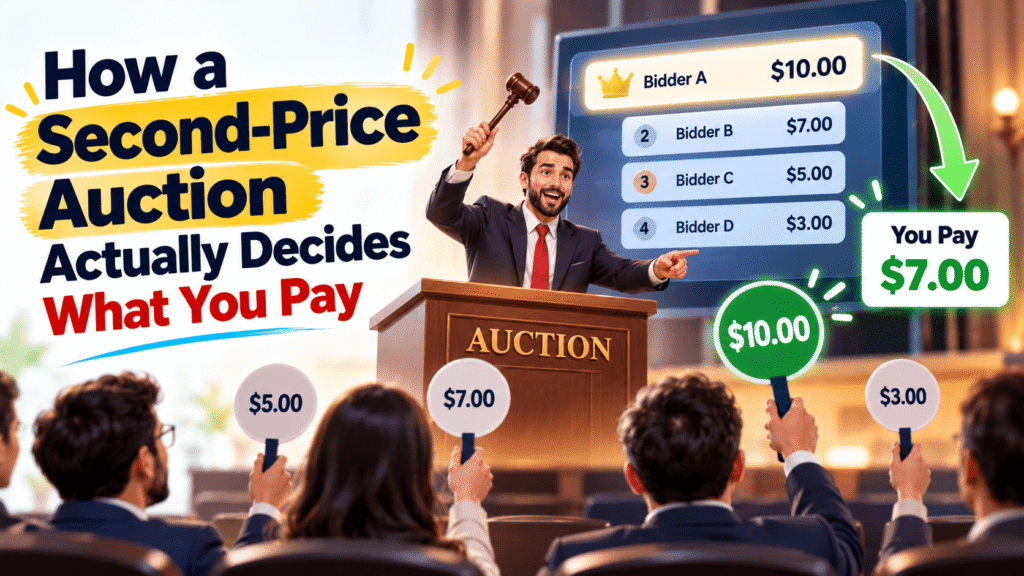
Imagine you are bidding against four other advertisers for the same ad placement.
You bid $10.
The next highest bidder offers $7.
You win.
So, how much do you pay?
If you guessed $10, that’s where things get interesting.
In a traditional second-price auction, the winner doesn’t pay their own maximum bid. Instead, the winner generally pays an amount based on the next-highest competing bid.
That simple idea has made the second price auction one of the most useful concepts to understand in digital advertising, auctions, and marketing technology.
But there is an important catch: not every modern ad auction works as a simple second-price auction, and Google Search Ads should not be described as a straightforward second-price auction.
So let’s break down second price auction explained in a practical way.
What Is a Second-Price Auction?
A second-price auction is an auction where the highest bidder wins, but pays based on the second-highest competing bid, rather than simply paying their own bid.
The classic version is also known as a Vickrey auction, named after economist William Vickrey.
Here’s a simple example.
Imagine four advertisers are bidding for one advertising opportunity:
| Advertiser | Bid |
| Advertiser A | $10 |
| Advertiser B | $7 |
| Advertiser C | $5 |
| Advertiser D | $3 |
Advertiser A has the highest bid, so A wins.
But under a simple second-price mechanism, A doesn’t pay $10.
Instead, the price is determined by the next-highest bidder.
So the winning price would be approximately
$7
The winner offered $10 but only needed to beat the competing $7 bid.
That’s the basic idea behind a second price auction.
Why Would Anyone Bid $10 If They Only Pay $7?
This is the clever part.
Suppose you believe an advertising opportunity is worth up to $10 to your business.
You could bid $6 because you hope nobody else bids higher.
But if another advertiser bids $8, you lose.
In a traditional second-price mechanism, bidding your true maximum value can make more sense because winning doesn’t necessarily mean paying your full bid.
For example:
- Your maximum value: $10
- Competitor’s bid: $7
- Your bid: $10
- You win
- Your payment: approximately $7
Now imagine your competitor bids only $4.
You still win, but your price falls accordingly.
This creates an interesting relationship between what you are willing to pay and what you actually pay.
A Simple Second-Price Auction Example
Let’s make this even easier.
Suppose you are advertising a pair of running shoes.
Five advertisers enter an auction.
Their bids are:
- You: $8
- Competitor A: $6
- Competitor B: $5
- Competitor C: $3
- Competitor D: $2
You have the highest bid.
Under a simple second-price auction, you win because your $8 bid is the highest.
But you don’t necessarily pay $8.
The next-highest bid is $6.
So your clearing price would be based on that competing bid, subject to the auction’s specific rules.
You bid $8. You win. The competing bid determines the price.
That’s the core concept people are usually looking for when they search for second price auction explained.
What Is the Difference Between First-Price and Second-Price Auctions?
The easiest way to understand a second-price auction is to compare it with a first-price auction.
First-price auction
The highest bidder wins and pays their own winning bid.
Example:
Your bid: $8
Second-highest bid: $6
You pay: $8
Second-price auction
The highest bidder wins, but the price is based on the next-highest competing bid.
Example:
Your bid: $8
Second-highest bid: $6
You pay: approximately $6
Here’s the difference:
| Auction Type | Highest Bid | Winner | General Pricing Logic |
| First-price | $8 | You | Winner pays own bid |
| Second-price | $8 | You | Winner pays based on next-highest bid |
This distinction is extremely important in programmatic advertising, where auction mechanics determine how advertisers compete for individual ad opportunities.
How Does a Second-Price Auction Work in Programmatic Advertising?
Programmatic advertising can make an auction happen incredibly quickly.
A user opens a webpage.
An advertising opportunity becomes available.
A supply-side platform, exchange, and demand-side platforms may participate in the process.
Advertisers evaluate the opportunity and submit bids.
The auction determines the winner and clearing price.
Play2Lrn has an interactive simulation specifically for understanding this process. The Display Programmatic Advertising simulation walks through an illustrative real-time bidding flow, including the publisher, SSP, exchange, DSPs, advertiser bids, second-price auction, clearing price, and ad rendering. (Play2Lrn)
And because you can step through the process rather than just read about it, you can see where the auction fits into the larger advertising ecosystem.
Is Google Ads a Second-Price Auction?
This stage is where you need to be careful.
You will often see older explanations describing Google Ads as a second-price auction.
That’s an oversimplification for modern Google Search Ads.
Google’s current documentation explains that search ads are ranked using ad rank, which considers factors including the bid, ad quality, ad rank thresholds, auction competitiveness, search context, and expected impact of assets and other formats. (Google Help)
Google also says your actual CPC is often less than your maximum CPC because you generally pay the minimum amount required to clear the relevant Ad Rank threshold and beat the competing Ad Rank for the position. (Google Help)
So while the “pay the second-highest bid” explanation is useful for understanding a traditional second-price auction, it should not be presented as the exact formula for today’s Google Search Ads.
That’s an important distinction for marketers.
So How Does the Winner’s Price Actually Get Determined?
Think of an ad auction as more than just:
Highest bid wins.
Modern ad auctions can consider multiple factors.
For Google Search Ads, Ad Rank incorporates factors such as:
- Bid
- Ad quality
- Landing-page quality
- Ad Rank thresholds
- Competition
- Search context
- Expected impact of assets and other ad formats
Google states that an advertiser with a lower bid can sometimes achieve a higher position and lower price when their ad is more relevant and higher quality. (Google Help)
This is why understanding auction mechanics is more useful than memorizing one formula.
What Happens If There Is Almost No Competition?
Here’s another interesting part of auction pricing.
Suppose your ad has enough Ad Rank to show, but there isn’t another advertiser immediately competing for the same position.
You might assume:
“Then I pay almost nothing.”
Not necessarily.
Google explains that actual CPC can depend on Ad Rank thresholds, including a reserve price when there isn’t an eligible competitor immediately below you. (Google Help)
So even when competition is limited, there can still be a minimum amount required to qualify for a particular ad position.
Again, this is why modern ad auctions shouldn’t be reduced to a simple “highest bidder pays the second-highest bid” rule.
Why Does the Second-Price Auction Matter to Marketers?
If you work in PPC, programmatic advertising, performance marketing, or paid media, understanding auction models helps you understand why the price of advertising changes.
Your bid isn’t necessarily the same thing as your final cost.
Competition can change.
The value of the advertising opportunity can change.
The auction mechanism can change.
The context of the user can change.
And in systems such as Google Ads, the quality and relevance of your ad can also influence Ad Rank and actual CPC. (Google Help)
That’s why two advertisers targeting similar searches can sometimes experience very different results.
Want to See an Ad Auction Instead of Just Reading About It?
This is exactly where interactive learning becomes useful.
Play2Lrn’s Search Ad Auction Simulator is designed as a teaching model of a Google-style search advertising auction. You can change the keyword, bid, headlines, description, landing-page keywords, load time, mobile experience, and assets, then watch a transparent teaching proxy calculate factors such as expected CTR, ad relevance, landing-page experience, Quality Score, and Ad Rank. (Play2Lrn)
It is explicitly a teaching proxy, not Google’s real auction or its real weights, which makes it useful for learning the underlying concepts without pretending to reproduce Google’s proprietary system.
Try changing one variable at a time.
Raise the bid.
Improve the ad relevance.
Change the landing page.
Then see what happens to the simulated ranking.
That’s much easier to understand than staring at a definition.
Second-Price Auction vs. Real-World Ad Auctions
Here’s the takeaway:
A traditional second-price auction is easy to understand:
Highest bidder wins → winner pays based on the next-highest bid.
But real-world advertising platforms can be considerably more complicated.
For programmatic advertising, you may encounter different auction mechanisms and rules depending on the platform and environment.
For Google Search Ads, today’s auction uses Ad Rank, thresholds, quality, context, competition, bids, and other signals, so calling it simply a second-price auction doesn’t accurately describe the complete system. (Google Help)
Understanding that distinction will make you a much better paid-search or programmatic marketer.
Frequently Asked Questions About Second-Price Auctions
What is a second-price auction?
A second-price auction is a mechanism where the highest bidder wins, while the price is generally determined by the next-highest competing bid rather than the winner’s full bid.
Who pays in a second-price auction?
The winning bidder pays the auction’s applicable clearing price. In the classic second-price model, this is based on the second-highest bid.
Is a second-price auction the same as a Vickrey auction?
A classic sealed-bid second-price auction is commonly called a Vickrey auction. The broader advertising ecosystem can use variations that don’t exactly match the classic mechanism.
Does Google Ads use a second-price auction?
Google Search Ads should not be described as a simple second-price auction. Google currently describes its Search auction in terms of Ad Rank, thresholds, bids, ad quality, competition, context, and other factors. (Google Help)
Why is the second-highest bid important?
In a traditional second-price auction, the next-highest bid helps determine how much the winner pays. This means the winner’s maximum bid and final payment can be different.
Final Takeaway
The easiest way to remember second price auction explained is this:
You can win with the highest bid without necessarily paying your highest bid.
In the classic model, the highest bidder wins and pays based on the second-highest bid.
But when you move into modern digital advertising, things become more nuanced. Programmatic platforms can use different auction mechanics, while Google Search Ads use a broader Ad Rank system rather than a simple second-price formula.
If you want to understand the difference by actually experimenting with the variables, start with the Play2Lrn Search Ad Auction Simulator and then explore the Display Programmatic Advertising simulation.
Because sometimes the fastest way to understand an auction isn’t to read another definition.
It’s to change the bid and watch what happens.