
What Is Quality Score in Google Ads?
If you have ever run Google Search Ads, you have probably seen a little number next to your keywords that ranges from 1 to 10.
That number is your Quality Score.
But what does it actually mean?
And does getting a 10 automatically mean you will pay less for every click?
Not quite.
When people search for what is Quality Score Google Ads, they often expect a simple formula. But Quality Score is better understood as a diagnostic tool that helps you understand how your keyword, ad, and landing page compare with other advertisers competing for similar searches.
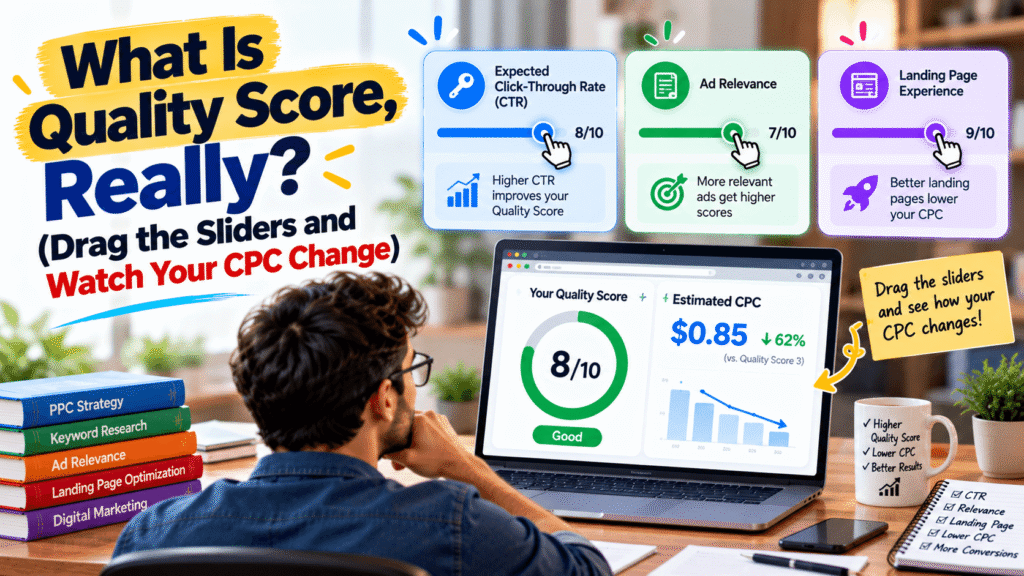
Google describes Quality Score as a keyword-level score from 1 to 10. It is based on three main components: expected click-through rate, ad relevance, and landing page experience. (Google Help)
And this is where things get interesting.
You can see the basic idea in action with the Play2Lrn Search Ad Auction Simulator, where you can change ad and landing-page variables and watch a teaching model calculate quality score and ad rank. The simulator is explicitly a teaching proxy, not Google’s real auction or its real weighting. (Play2Lrn)
Let’s break it down.
How Does Google Ads Quality Score Work?
Think of the quality score as a quick diagnostic report.
Google evaluates three major areas:
- Expected CTR
- Ad relevance
- Landing page experience
Each component receives a status such as Above average, Average, or Below average. Google says these evaluations are based on comparisons with other advertisers whose ads appeared for the same searches over the previous 90 days. (Google Help)
So, if your quality score is 5/10, that doesn’t mean your ad is automatically “bad.”
It means there are areas where your ad quality may be less competitive relative to other advertisers for the relevant searches.
That distinction matters.
1. Expected CTR: Will People Want to Click?
The first part of Quality Score is expected click-through rate, or expected CTR.
In simple terms, Google is asking:
“When this ad appears for this search, how likely is someone to click it?”
Suppose someone searches:
“running shoes for beginners”
Compare two ads.
Ad A:
“Running Shoes | Shop Our Products”
Ad B:
“Running Shoes for Beginners | Lightweight Options | Shop Today”
The second ad gives the searcher more information about what they can expect.
That doesn’t mean Google will automatically give Ad B a higher Quality Score. But the example shows why relevance and compelling ad messaging matter.
Google recommends making ad text more specific, matching the user’s search intent, highlighting useful benefits, and testing calls to action when expected CTR is below average. (Google Help)
The goal isn’t simply to chase clicks.
You want the right people to click.
2. Ad Relevance: Does Your Ad Match the Search?
The second component is ad relevance.
This asks how closely your advertisement matches the intent behind the user’s search.
Imagine you have a campaign selling running shoes.
Your keywords include:
“men’s running shoes”
But your ad talks almost entirely about:
“women’s hiking boots.”
There is a mismatch.
The searcher wants one thing, while your ad is talking about something else.
Google recommends organizing keywords into tightly related themes and creating ads that closely match those themes. (Google Help)
This is one reason overly broad ad groups can create problems.
If one ad group contains:
- running shoes
- hiking boots
- basketball shoes
- children’s sneakers
- formal shoes
it becomes difficult to write one highly relevant advertisement for every search.
A more focused structure can make it easier to align your keyword → ad → landing page.
3. Landing Page Experience: What Happens After the Click?
Getting the click is only half the story.
What happens next?
The user lands on your website.
Google evaluates landing page experience as part of Quality Score. The goal is to understand whether the landing page is relevant and useful to people who click the ad. (Google Help)
For example, imagine your ad says:
“Buy Men’s Running Shoes — Free Shipping”
But clicking the ad takes users to a generic homepage containing dozens of unrelated products.
That’s not a great experience.
A more relevant landing page could take the user directly to a page featuring men’s running shoes, with clear information, easy navigation, and the offer mentioned in the advertisement.
In other words:
Search → Ad → Landing Page
The experience should feel connected.
Does a Higher Quality Score Lower Your CPC?
This is where many Google Ads explanations become confusing.
You may hear:
“Increase your Quality Score and Google will lower your CPC.”
There’s some truth behind the relationship, but that statement is too simplistic.
Quality Score itself is not an input in the ad auction.
Google specifically says Quality Score is a diagnostic tool, not a KPI to optimize or a direct auction input. (Google Help)
However, the underlying ad-quality signals related to expected CTR, ad relevance, and landing page experience are considered in the auction.
Google also states that higher-quality ads can often result in a lower actual CPC and can contribute to better Ad Rank. (Google Help)
So the relationship looks more like this:
Better ad quality → stronger auction performance → potentially better position and lower CPC
rather than:
Quality Score 10 → automatically cheap clicks
That’s an important difference.
Quality Score vs. Ad Rank: They Are Not the Same
Another common mistake is treating Quality Score and Ad Rank as the same metric.
They aren’t.
Quality Score is a diagnostic metric available at the keyword level.
Ad Rank is used during the auction to determine whether your ad can show and where it may appear.
Google says Ad Rank considers several factors, including your bid, ad and landing-page quality, Ad Rank thresholds, auction competitiveness, and the context of the search. (Google Help)
This is why two advertisers can have different bids and still end up in unexpected positions.
The advertiser bidding the most doesn’t necessarily get everything.
Quality and relevance matter too.
Want to See Quality Score in Action?
Reading about Quality Score is useful.
But actually changing the variables and watching the outcome change is a different experience.
That’s exactly the idea behind Play2Lrn.
In the Search Ad Auction Simulator, you can experiment with elements such as:
- Keyword
- Bid
- Headlines
- Description
- Landing-page keywords
- Load time
- Mobile experience
- Assets
The simulator then shows a teaching model of Expected CTR, Ad Relevance, Landing Page Experience, Quality Score, and Ad Rank. (Play2Lrn)
You can also see how a higher-quality, lower-bid ad can potentially outrank a weaker ad with a higher bid in the simulation.
That’s the point of interactive learning: instead of memorizing a definition, you can change something and see what happens.
How Can You Improve Quality Score?
If you’re seeing Average or Below average components, don’t obsess over getting a perfect 10.
Instead, diagnose the underlying problem.
Improve ad relevance
Make sure your ads closely match the themes and intent of your keywords.
Improve expected CTR
Write specific, useful ads that clearly communicate what the searcher will get.
Improve landing page experience
Make sure the landing page delivers what the ad promises and provides a useful, relevant experience.
Organize your keywords
Group closely related keywords together so your advertisements can speak directly to the searcher’s intent.
Look beyond Quality Score
Don’t optimize the number just because it is easy to see.
Google recommends using Quality Score as a diagnostic signal while keeping your broader performance goals in focus. (Google Help)
Your real business goals might include:
- More qualified leads
- More sales
- Lower cost per conversion
- Better ROAS
- Higher conversion rates
- Sustainable customer acquisition
A Quality Score of 10 isn’t useful if your campaign doesn’t generate profitable results.
So, What Is Quality Score in Google Ads Really?
The simplest answer is:
Quality Score is Google’s 1–10 diagnostic metric for evaluating the quality and relevance of a keyword’s ad experience.
It looks at three primary components:
Expected CTR + Ad Relevance + Landing Page Experience
But don’t make the mistake of treating Quality Score as the ultimate Google Ads performance metric.
It isn’t.
Think of it more like a dashboard warning light.
If the score or one of its components is weak, investigate why.
Is the ad poorly matched to the keyword?
Is the message not compelling enough?
Is the landing page irrelevant?
Once you understand the underlying problem, you can make a meaningful improvement.
And if you want to understand the mechanics rather than simply memorize them, try the Play2Lrn Search Ad Auction Simulator and experiment with the variables yourself. That’s where Quality Score starts making a lot more sense.