
What Are SEO Ranking Factors?
If you have ever searched for SEO ranking factors, you’ve probably seen massive lists claiming there are hundreds of things Google checks before deciding where a page should appear.
Some lists make SEO sound like a giant checklist:
Keywords. Backlinks. Speed. Schema. HTTPS. Headings. Images. Mobile.
Do all of them matter?
Yes, but not in the way many SEO checklists make it seem.
Google doesn’t publish one master list of “200 ranking factors” with a fixed weight assigned to every item. Its Search systems use many signals and systems to determine which results are useful and relevant for a particular query.
That means SEO isn’t about ticking every possible box.
It’s about making your website easy for search engines to understand and useful for people to use.
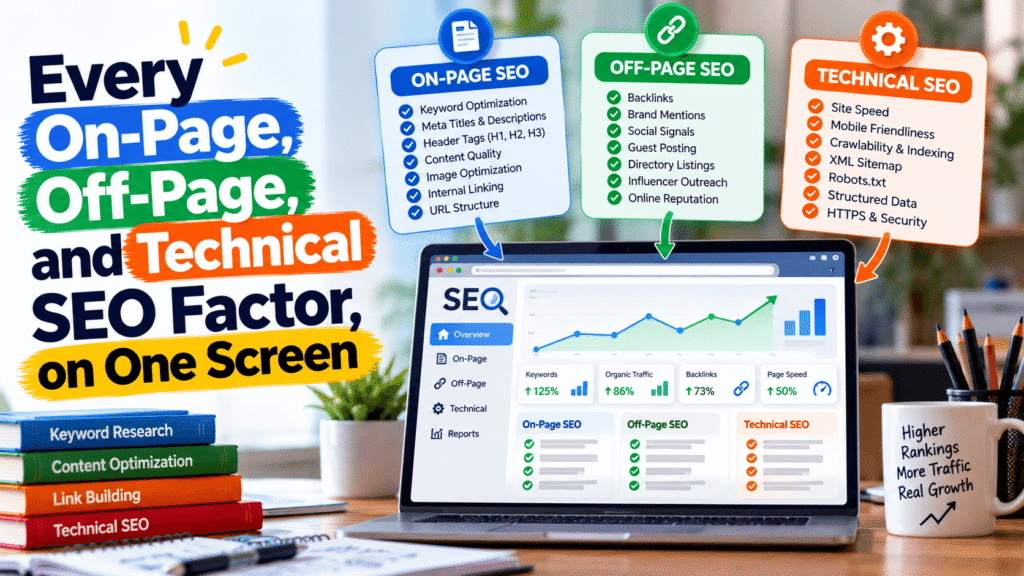
A helpful way to organize the major SEO ranking factors is into three broad areas:
- On-page SEO
- Off-page SEO
- Technical SEO
Then there is a fourth layer that connects everything:
User experience and content quality.
Let’s put the whole picture together.
1. On-Page SEO Ranking Factors
On-page SEO is everything you can optimize on the page itself.
This is usually where SEO beginners start because you have direct control over these elements.
Keyword and Topic Relevance
Your page needs to clearly address the topic behind the search query.
If you’re writing about “SEO ranking factors,” the page shouldn’t spend 1,000 words talking about social media marketing without explaining how search visibility works.
Use the main topic naturally in:
- Page title
- Main heading
- Introduction
- Relevant subheadings
- Body content
- Image descriptions where appropriate
- Internal links where useful
But don’t turn the page into a keyword-repetition exercise.
Google’s spam guidance specifically warns against repeating the same words or phrases unnaturally. (Google for Developers)
The goal is topic clarity, not keyword stuffing.
Search Intent
One of the most important on-page considerations is understanding what the searcher actually wants.
Someone searching:
“what are SEO ranking factors?”
probably wants an explanation.
Someone searching:
“SEO audit tool”
may want a tool.
Someone searching:
“SEO agency near me”
has a different goal again.
Your content needs to match the intent behind the query.
This is also why our Search Intent Classifier fits naturally into the SEO learning cluster. Instead of simply memorizing intent categories, you can experiment with different queries and see how changing the wording can change the likely intent.
2. Content Quality and Helpfulness
Having keywords on a page doesn’t automatically make it useful.
Imagine two articles targeting exactly the same keyword.
Article A:
“SEO ranking factors are things that affect SEO rankings. Keywords are important. Backlinks are important. Technical SEO is important.”
Article B:
Actually explains:
- What each factor means
- Why it matters
- How it relates to other factors
- What mistakes to avoid
- How to diagnose problems
- Practical examples
Which would you rather read?
Probably Article B.
That’s the basic principle behind useful SEO content.
Google says its core ranking systems aim to show helpful and reliable information created primarily to benefit people, rather than content created mainly to manipulate search rankings.
So when thinking about SEO ranking factors, don’t ask only:
“What keyword should I use?”
Also ask:
“Does this page genuinely solve the searcher’s problem?”
3. Title and Headings
Your title helps both users and search engines understand what a page is about.
A good title should be:
- Descriptive
- Relevant
- Clear
- Concise
- Useful to the searcher
Your headings then organize the page.
For a guide about SEO ranking factors, a logical structure might look like:
H1: SEO Ranking Factors
H2: On-Page SEO Factors
H2: Off-Page SEO Factors
H2: Technical SEO Factors
H2: Content and User Experience
H2: How to Prioritize SEO Improvements
This isn’t about inserting keywords into every heading.
It’s about making the page easy to understand and navigate.
4. Internal Linking
Internal links connect one page on your website to another.
They’re useful for both users and search engines because they create relationships between related pieces of content.
For example, this article could link to:
- Search intent
- Search engine crawling
- Quality Score
- Search auctions
- Content optimization
On Play2Lrn, this becomes especially useful because the simulations naturally form topic clusters.
The content strategy identifies a Search & SEO cluster inside the broader Marketing & Growth pillar, including ranking factors and search intent.
So instead of publishing isolated articles, you can build a connected learning ecosystem.
5. Technical SEO Ranking Factors
Now let’s move behind the page.
Technical SEO is about helping search engines crawl, render, understand, and index your website.
Some important technical areas include:
Crawlability
Can search engine crawlers access the pages you want indexed?
Problems with robots.txt, blocked resources, broken links, or incorrect directives can make crawling more difficult.
Indexability
A page can be crawlable but still not eligible for indexing.
For example, a noindex directive tells search engines not to include the page in their index.
Site Architecture
Your website should have a logical structure.
Important pages shouldn’t be buried beneath a maze of unrelated URLs.
A clear architecture helps users and search engines understand how pages relate to one another.
XML Sitemap
An XML sitemap can help search engines discover URLs on your website.
It doesn’t guarantee indexing or rankings, but it can support discovery and crawling.
Canonical URLs
Canonicalization helps communicate which URL should be treated as the preferred version when similar or duplicate URLs exist.
HTTPS
Your website should be served securely using HTTPS.
Security is also part of providing a good overall experience for visitors.
6. Page Speed and Core Web Vitals
Nobody enjoys waiting for a page to load.
Google’s page-experience documentation recommends paying attention to Core Web Vitals, mobile usability, secure delivery, intrusive interstitials, excessive ads, and the overall usability of the page. (Google for Developers)
The Core Web Vitals focus on areas such as:
- Loading performance
- Responsiveness
- Visual stability
But here’s an important point:
A perfect PageSpeed score does not guarantee a top Google ranking.
Google explicitly says that good Core Web Vitals don’t guarantee that a page will rank at the top of Search. (Google for Developers)
So don’t spend weeks chasing a perfect technical score while ignoring content quality and search intent.
SEO works as a system.
7. Mobile Experience
Your users may visit your website from:
- Phones
- Tablets
- Laptops
- Desktop computers
Your content should work well across screen sizes.
Check:
- Font readability
- Navigation
- Buttons
- Forms
- Images
- Interactive elements
- Page layout
This becomes especially important for Play2Lrn because the product itself is interactive.
If someone lands on an educational article from a mobile search and then tries to use a simulation, the experience should remain easy to navigate.
8. Structured Data
Structured data is another technical SEO element worth understanding.
It provides standardized information that helps Google understand what a page contains.
Depending on the page, supported structured-data features include things such as:
- Article
- Breadcrumb
- Product
- Event
- Organization
- Profile page
- Software app
Google explains that structured data can help it understand page content and make pages eligible for certain search features, although using structured data does not guarantee that a rich result will appear. (Google for Developers)
For a blog article, Article structured data may be appropriate when implemented correctly.
For interactive software or simulation pages, the applicable markup depends on what the page actually represents.
The important rule is:
Don’t add schema simply because you heard it is a ranking factor.
Use structured data when it accurately describes the content.
9. Off-Page SEO Ranking Factors
Now we leave your website.
Off-page SEO refers to signals and activities that happen outside your own website.
The biggest area people usually talk about is links.
Backlinks
A backlink is a link from another website to your website.
Quality matters more than simply collecting huge numbers of links.
A relevant link from a respected educational, marketing, technology, or industry resource can be much more meaningful than hundreds of random directory links.
This is particularly relevant for Play2Lrn.
The content strategy specifically identifies explorable explanations communities and curated resource lists as potential sources of referral traffic and backlinks because Play2Lrn’s interactive simulations fit that ecosystem.
That’s a much more natural link-building strategy than creating hundreds of low-quality links.
10. Relevance and Authority Matter
Imagine two websites linking to your SEO article.
Website A:
A random site about unrelated coupons.
Website B:
A respected marketing publication discussing search engine optimization.
The second link is much more contextually relevant.
That’s why modern SEO isn’t simply:
More backlinks = better rankings.
You should think about:
Relevance + quality + editorial context + usefulness.
And avoid link schemes designed primarily to manipulate rankings. Google’s spam policies specifically identify link spam as a prohibited practice. (Google for Developers)
11. Brand and Reputation
People often search for brands directly.
They may also mention brands across websites, publications, communities, and social platforms.
Building a recognizable brand can therefore support the broader ecosystem around your organic search strategy.
For Play2Lrn, this means the SEO strategy doesn’t have to stop at:
“Rank for SEO ranking factors.”
It can also build awareness around the larger concept:
Interactive learning through simulations.
That’s a much stronger long-term positioning than trying to rank every article independently.
12. What About Social Media?
Social media can help distribute your content and generate awareness.
Someone sees a Play2Lrn simulation on LinkedIn.
They click it.
They try the simulation.
They share it.
Someone else discovers the website.
That can create referral traffic, brand awareness, and potentially links.
But don’t treat social likes as a guaranteed direct Google ranking signal.
Instead, think of social as a distribution channel that can indirectly support your SEO ecosystem.
The Play2Lrn content strategy recommends LinkedIn, Twitter/X, Medium, Instagram, TikTok, and YouTube Shorts alongside the website blog, with different pillars matched to different channels.
13. The Biggest SEO Ranking Factor? Don’t Think That Way
Here’s where many SEO strategies go wrong.
They ask:
“What is the #1 SEO ranking factor?”
There isn’t a universal answer that works for every query and every page.
Search results depend on the query, context, content, competition, and many other signals.
Instead of searching for one magic factor, think in systems.
On-page
Does the page satisfy the topic and intent?
Technical
Can search engines access, understand, and process it?
Off-page
Does the website have relevant external recognition and references?
Experience
Can people actually use the page comfortably?
That framework is much more useful than memorizing a giant list.
See SEO Ranking Factors on One Screen
This is where Play2Lrn’s SEO Ranking Factors simulation becomes useful.
Instead of reading a giant checklist, the simulation is designed to bring the major SEO concepts together in one interactive environment.
You can think about SEO as a connected system:
Content → Relevance → Technical accessibility → Authority → User experience
Change one part and consider how it affects the overall picture.
That is the philosophy behind Play2Lrn’s interactive approach: concepts that are difficult to understand from static text can become easier when you can experiment with them.
A Simple SEO Ranking Factors Checklist
Before publishing or optimizing a page, ask:
On-Page SEO
- Does the page match search intent?
- Is the primary topic clear?
- Is the title descriptive?
- Are headings logically structured?
- Does the content answer the user’s questions?
- Are internal links relevant?
- Are images useful and properly described?
Technical SEO
- Can Google crawl the page?
- Can the page be indexed?
- Is the canonical URL correct?
- Is the site mobile-friendly?
- Does the page load efficiently?
- Are Core Web Vitals reasonable?
- Is HTTPS enabled?
- Is structured data appropriate?
Off-Page SEO
- Does the content deserve links?
- Are backlinks relevant?
- Are links coming from legitimate sources?
- Is the brand being discovered beyond search?
Content Quality
- Is the information useful?
- Is it accurate?
- Is it original or meaningfully useful?
- Does it actually satisfy the searcher?
- Would a real person recommend the page?
Final Takeaway
There isn’t one magic checklist that guarantees Google rankings.
The major SEO ranking factors can be understood through three practical groups:
On-page SEO
Make the content relevant, useful, well structured, and aligned with search intent.
Technical SEO
Make the site accessible, crawlable, indexable, fast enough, secure, and usable.
Off-page SEO
Build genuine authority through relevant mentions, references, relationships, and links.
Then bring everything together with a good user experience.
Google’s own documentation emphasizes that Search uses many systems and signals rather than one universal ranking signal, and that page experience is one part of a broader picture. (Google for Developers)
So instead of asking:
“What is the one SEO ranking factor I need to fix?”
Ask:
“What is stopping this page from being the most useful result for this search?”
That’s a much better SEO question.
And if you want to see the concepts interact rather than just read another checklist, try the SEO Ranking Factors simulation on Play2Lrn.
Don’t just memorize SEO ranking factors. See how the pieces fit together.